Thursday, August 6, 2009

LIVE FOREVER


“Music has been my outlet, my gift to all of the lovers in this world. Through it, my music, I know I will live forever. ”

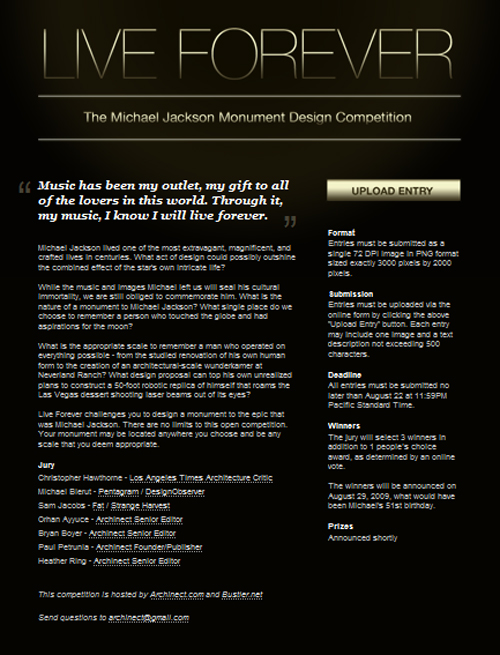
Michael Jackson lived one of the most extravagant, magnificent, and crafted lives in centuries. What act of design could possibly outshine the combined effect of the star's own intricate life?

While the music and images Michael left us will seal his cultural immortality, we are still obliged to commemorate him. What is the nature of a monument to Michael Jackson? What single place do we choose to remember a person who touched the globe and had aspirations for the moon?

What is the appropriate scale to remember a man who operated on everything possible -from the studied renovation of his own human form to the creation of an architectural-scale wunderkamer at Neverland Ranch? What design proposal can top his own unrealized plans to construct a 50-foot robotic replica of himself that roams the Las Vegas dessert shooting laser beams out of its eyes?

Live Forever challenges you to design a monument to the epic that was Michael Jackson. There are no limits to this open competition. Your monument may be located anywhere you choose and be any scale that you deem appropriate.

Jury
Christopher Hawthorne - Los Angeles Times Architecture Critic
Michael Bierut - Pentagram / DesignObserver
Sam Jacobs - Fat / Strange Harvest
Orhan Ayyuce - Archinect Senior Editor
Bryan Boyer - Archinect Senior Editor
Paul Petrunia - Archinect Founder/Publisher
Heather Ring - Archinect Senior Editor


This competition is hosted by Archinect.com and Bustler.net

Friday, July 31, 2009

Art Review; Moss, Kipnis and the Box


CONVERSATION UNDER THE BOX
By Orhan Ayyuce

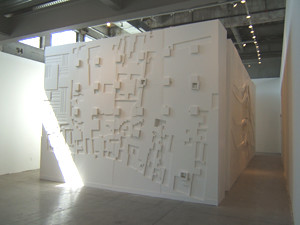
I almost didn't go if it wasn't for a business meeting I had near SCI Arc right before the much anticipated gallery installation talk between Eric Owen Moss, architect and school's director and his friend and critic Jeffrey Kipnis about ; architecture related, grid related, art related, poetry related, related over the top and 'what's inside of me' personal installation of aluminum produced cube, precariously hanging from the ceiling above, bondaged with finite, centered circular flat bars, fighting a war against orthographic and infinite grid.

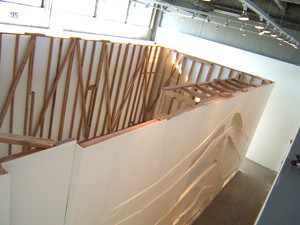
An integral part of the visual concept, the exhibition incorporated a boxing ring or some other theatrics influenced seating arrangement, demanding your focused attention to the work uber alles. If you were sitting in the gallery, you were either an actor or an audience, a part of the performance piece that was half there half was not. And like me, if you were watching the whole set up from up above, you were the overflow looking at the work from an eye level, sort of up close and personal way.Down below, the uncompromised wooden chairs similar to those depicted in the rendering were full.The conversation started with few anecdotes and talk show jokes to get the people relaxed.

Predictably, the territory of art and architecture challenged as the first conceptually 'serious' issue. I have seen that before and done it myself. That is usually and rightfully a typical argument of architect produced installations when dressed as art in a gallery for not art but for architecture.
Under the 8'x8' cube bondaged with circular ribbons:“What's inside the cube and what you don't see, what this work is about,” answered the author to a question that could be summarized as, “what is this?” Yes, and no surprise to me at that point, it was declared “art.”The audience was asked to go 'inside the box' and find out for themselves.

Sure, I will go see what is inside "The Center of The Universe” by Bruce Nauman in University of New Mexico campus in Albuquerque, but do I want to know what the 4'x8' aluminum sheets are screwed to? And bother to know the lyrics of the bondage song? Perhaps I would, but rendering of the bigger scheme of things at the gallery entrance hardly left any curiosity in this reviewer's mind.

Obviously and as stated by the architect that was what resided in the box. Like the attendees, I knew.Yes, most art is autobiographical but architects are architects. We have buildings. It is less interesting when it is both ways. And sometimes that goes for artists declaring their work architecture with no convincing text or function.
In fact, for me, the territory of art and architecture is not that casual and easy. There is precedent.
As for the grid discussion in art, I will stick to Rosalind Krauss' “Grids” essay I read many *Octobers ago. Recommended to all interested in art via grid related way...

Getting back to the gallery talk, the rest of the apologies of courage and bravery to inspire the students etc., did not make the free fall of the cube any less harmless or any more meaningful.
There was even a Jenny Holzer comparing / compensating attempt at one point when I said “oh no.”

And as if by default, this crowd's go-to guy Peter Eisenman with his 'easier piece' was the anchor at one point, even in his physical absence. He was still ruling maybe because the audience could see what's inside his box, I was pondering on the freeway, driving home.

However, credit does go to always vulnerable Mr. Moss for fearless and semi stable homecoming. Courageous, yes. Exposed, yes. Mediocre as art, yes.

Jeffrey Kipnis, the interviewer, the conversational theorist, an insider, is cynical, yet so sweet...

“Architecture needs an enemy,” says Eric Moss, but does art need a friend?

*"Grids" from October #9, Summer 1979 pp. 9-22 MIT Press.

The article was originally published at Archinect.com

Saturday, July 11, 2009

SAME BLOBS SAME

Photo; OA, 07/09 (poster; collection of the author)

This post is based on a Nam Henderson titled news item in Archinect, about “Transitory Objects,” the latest exhibit at Vienna’s influential Thyssen-Bornemisza Art Contemporary Gallery.

There is an element of 'a safe' resolve in these pieces. Not inspiring but merely scratching the surface as plastic art.
Lynn's ideas are still the most exciting here, but he is looking more and more like the road show with this circle.
You can only hold on the rope too long without the building important buildings that revolutionize the production, use and economy as well as the way of living. No, Zaha won't be able to save too many people either. She is all in for herself and there is only so much room.

A gallery is a tired place for it after all these years.

In architecture, modernists, post modernists and others too, produced belt buckles, dinnerware, walls and curves, but they were producing the real buildings as well, in real time, live.
Some of blob work caught on fire but didn't transfer as good. Soon, I predict, there will be less press interest in it.

There is something to be said about blobs' strong appearance not too long ago and relatively fast disappearance in last few years.

A lot of the building ideas produced here are unbuildable, most are software driven work and they don't provide much useful info on immediate issues on hand and on the ground.
After 'we get it' that a lot can be done with computers as far as configuring the endless curves, we realize structures of the plastic minds (no pun) match the depictions of fluid pencil and stream of imagineering.

Indeed it is a loss that strong ideas ending up as decorative objects, lobby art, glue gunned together for the structural stability and sold by the unit count.

I could also ask "where do we go from here?" but it already feels like we have arrived.


Also see;
'Every home should have a Greg Lynn blobwall' by Bruce Sterling for Wired Magazine

Picturesque Life: View Property #1

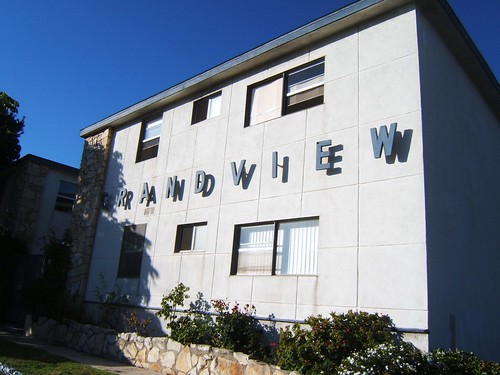
Photo; OA 07/09

Tuesday, June 30, 2009

Baroness Margaret Ford: "SIZE MATTERS!"


The plans for the 2012 Olympic Stadium in London keeps changing. Seemingly progressive and original plan of resizable stadium might be a victim to conservative and corporate mind of Margaret Ford, a Baroness who is now in charge of the Olympic Legacy Team, an organization responsible for figuring out post Olympic use of the venue.
One of her main goal is to make stadium's size of 80,000 spectators permanent.
The Olympic Stadium was designed around the idea that it can be retracted to size of 25,000 spectators after the Olympics, reducing the impact on the environment by that much and still remain as an intimate but large enough sports venue, also making a statement on the Olympic extravaganza we are accustomed to expect in recent decades and in the face of increasing poverty rates around the Globe.


BD online

News at Archinect